
Book Appointment Now
Receding Hairline Treatment in Nagpur: Signs, Causes & Treatment Options
A hairline rarely changes overnight. In many people, recession begins gradually around the temples or front of the scalp and becomes more noticeable over time.
Recognising the early signs can be important because a changing hairline may be one of the first indications of progressive hair loss.
If you are looking for receding hairline treatment in Nagpur, the first step should be understanding why the hairline is changing rather than immediately choosing a procedure.
What Is a Receding Hairline?
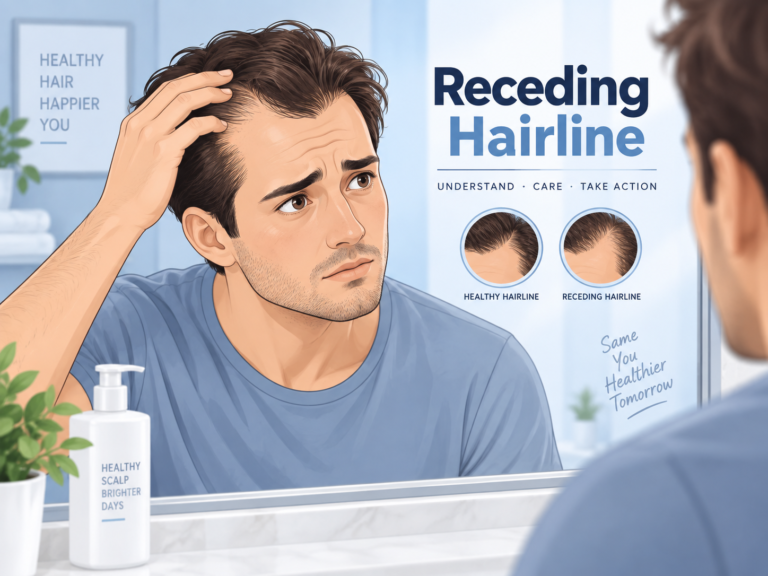
A receding hairline occurs when the hair along the front or temples gradually moves backwards.
The pattern can differ from person to person.
Some people notice recession mainly around both temples, while others develop thinning across the entire frontal hairline.
In men, progressive temple recession can sometimes create an M-shaped appearance.
Women may experience a different pattern, such as reduced density around the frontal scalp or widening of the hair part.
What Are the Early Signs of a Receding Hairline?
A changing hairline can be difficult to notice because progression may occur slowly.
Early signs may include:
- Increasing temple recession
- Hairline appearing higher than before
- Reduced density at the front
- Fine or weaker hairs around the hairline
- Greater scalp visibility near the temples
- Difficulty styling hair as before
- An increasingly uneven hairline
- Changes visible when comparing older photographs
If you are also noticing increased shedding or general thinning, read our guide on Early Signs of Hair Loss.
Is a Mature Hairline the Same as a Receding Hairline?
Not necessarily.
Some people experience a natural change in their hairline as they move from adolescence into adulthood.
A mature hairline may move slightly higher without continuing to progress significantly.
A receding hairline, however, may continue moving backwards over time and can be associated with progressive pattern hair loss.
Because it is not always easy to distinguish between the two, monitoring changes and obtaining professional evaluation can be useful.
What Causes a Receding Hairline?
There are several possible reasons for hairline recession.
Genetic Pattern Hair Loss
Genetic hair loss is one of the most common reasons for progressive hairline recession.
The follicles gradually become smaller and produce finer hairs over time.
Without appropriate management, this process may continue.
Age
Hair density and growth patterns can change with age.
Age alone does not necessarily mean significant hair loss will occur, but it can influence the way the hairline develops.
Hormonal Factors
Hormonal changes may contribute to certain patterns of hair thinning.
The exact pattern should be assessed rather than assuming every case has the same cause.
Stress
Significant physical or emotional stress can sometimes increase hair shedding.
Stress-related hair fall usually behaves differently from a steadily receding hairline, although both may occur together.
Nutritional Factors
Certain nutritional deficiencies may contribute to increased shedding or reduced hair quality in selected patients.
Scalp Conditions
Persistent inflammation, dandruff or other scalp problems may occur alongside hair loss and should be evaluated when symptoms are present.
If you are experiencing both flaking and increased shedding, read our guide on Dandruff and Hair Fall.
How Can You Tell If Your Hairline Is Getting Worse?
One of the easiest ways is to compare photographs over time.
Look at photographs taken six months, one year or several years apart and compare:
- Temple position
- Shape of the hairline
- Frontal density
- Scalp visibility
- Hair thickness near the front
Try to use photographs taken from similar angles and under similar lighting.
Progressive change over time is more useful than judging the hairline on one particular day.
Does a Receding Hairline Always Lead to Baldness?
No.
The pattern and degree of progression differ between individuals.
Some people experience mild recession that changes very slowly, while others may develop more extensive thinning around the front and crown.
This is why early evaluation can be useful.
A dermatologist can assess whether the hairline appears stable or is part of a progressive hair-loss pattern.
When Should You See a Dermatologist?
Consider getting your hairline evaluated when:
- Temple recession keeps progressing
- Your hairline looks noticeably different from older photographs
- Hair around the front is becoming finer
- Overall hair density is reducing
- Crown thinning is also developing
- You notice significant hair shedding
- Hair loss runs strongly in your family
- The scalp is becoming more visible
A dermatologist in Nagpur can evaluate the pattern of hair loss and determine whether treatment may be appropriate.
How Is a Receding Hairline Evaluated?
A dermatologist may assess several factors.
These may include:
- Hairline pattern
- Temple recession
- Existing hair density
- Crown condition
- Quality of the hair shafts
- Scalp health
- Family history
- Duration of progression
- Medical history
- Previous treatments
The objective is to determine whether the hairline is simply maturing, progressively receding or associated with another type of hair loss.
Can a Receding Hairline Grow Back?
This depends on the underlying cause and condition of the hair follicles.
If follicles remain active but have become weaker or miniaturised, certain treatment approaches may be considered.
Areas where follicles are no longer producing useful hair may behave differently.
This is why evaluating the stage of hair loss is important before discussing expected improvement.
What Treatments Are Available for a Receding Hairline?
There is no single treatment suitable for every patient.
The treatment depends on:
- Cause of recession
- Stage of hair loss
- Existing follicle condition
- Donor hair availability
- Age
- Expected future progression
- Individual treatment goals
Several approaches may be considered.
Medical Hair-Loss Management
Some forms of progressive hair loss may require dermatologist-guided medical treatment.
The specific approach depends on diagnosis and individual medical factors.
Treatment should generally be selected after professional evaluation rather than based only on online recommendations.
Hair Restoration for a Receding Hairline
Hair restoration is a broader strategy rather than one individual procedure.
Depending on the stage of hair loss, a Hair Restoration plan may involve different approaches designed to maintain existing hair and improve areas of thinning where appropriate.
GFC Hair Treatment
For selected patients who still have viable but weakened hair follicles, GFC Hair Treatment may form part of a broader hair restoration plan.
GFC uses concentrated growth factors prepared from the patient’s own blood.
It is not automatically suitable for every receding hairline.
The condition and density of existing follicles should first be evaluated.
You can learn more in our guide on GFC Hair Treatment in Nagpur.
Mesotherapy for Hair
Mesotherapy for Hair may also be considered in selected hair restoration plans.
It involves targeted delivery of selected ingredients into areas of the scalp.
Suitability depends on the patient’s hair-loss pattern and individual condition.
Read more in our guide on Mesotherapy for Hair in Nagpur.
When Is a Hair Transplant Considered?
Hair transplantation may be considered in selected patients with established permanent hairline recession.
A transplant works differently from non-surgical treatments.
Healthy follicles are obtained from a suitable donor area and redistributed into areas affected by permanent hair loss.
Important factors include:
- Donor hair availability
- Degree of recession
- Existing density
- Age
- Future hair-loss progression
- Hairline design
If you are researching surgical restoration, read our complete guide on Hair Transplant in Nagpur.
Why Hairline Design Matters in Hair Transplantation
A hair transplant should not simply aim to create the lowest possible hairline.
The design should consider:
- Age
- Facial proportions
- Existing hair pattern
- Donor availability
- Expected future hair loss
A very low or unnatural hairline may not age appropriately.
A conservative and personalised design can help create a more natural appearance.
Can GFC Fix a Receding Hairline?
GFC is not a replacement for every other hair restoration treatment.
It may be considered when suitable existing follicles remain in the affected area.
If an area has established permanent hair loss, another treatment approach may be required.
The correct decision depends on clinical assessment rather than the name of the treatment.
Can Mesotherapy Fix a Receding Hairline?
Mesotherapy may form part of a non-surgical hair restoration plan for selected patients.
However, it cannot be assumed to restore every case of advanced hairline recession.
Again, the stage and cause of hair loss should determine the treatment choice.
Why Early Evaluation Can Be Useful
Hairline recession may progress gradually for years.
The earlier stages can be subtle:
- Slight temple recession
- Fine hairs around the hairline
- Reduced density
- Increased scalp visibility
Once significant permanent hair loss has developed, treatment options may be different.
Early evaluation provides an opportunity to understand the pattern before making decisions about long-term management.
Common Mistakes with a Receding Hairline
Waiting Until Hair Loss Is Advanced
Gradual progression can be easy to ignore.
Comparing photographs can help identify changes earlier.
Trying Multiple Products Without Diagnosis
Hair oils, shampoos and cosmetic products generally cannot address every underlying cause of hairline recession.
Choosing a Procedure Too Early
The first question should be what is causing the recession, not which procedure is most popular.
Expecting Instant Regrowth
Hair growth follows a biological cycle, and treatment response develops gradually.
Ignoring Future Hair Loss
A good long-term plan should consider what may happen to the surrounding non-treated hair in the future.
Receding Hairline Treatment in Nagpur at Trichoderm Centre
With 8+ years of experience and 10,000+ patients treated, the clinic follows a personalised, safe and evidence-based approach to hair and scalp care.
Depending on the diagnosis, a treatment plan may involve Hair Restoration, GFC Hair Treatment, Mesotherapy for Hair or hair transplantation for suitable patients.
Frequently Asked Questions About Receding Hairline
What is the first sign of a receding hairline?
One of the earliest signs is gradual recession around the temples. You may also notice reduced frontal density or finer hairs near the hairline.
Can a receding hairline stop naturally?
Some hairlines remain relatively stable, while others continue progressing. Monitoring changes over time and professional evaluation can help determine the pattern.
Is a receding hairline always genetic?
No. Genetics are a common factor, but hair loss can also be affected by other medical, nutritional, hormonal or scalp-related conditions.
Which doctor treats a receding hairline?
A dermatologist evaluates hair and scalp disorders and can determine the likely cause of progressive hairline recession.
Can GFC be considered for a receding hairline?
GFC may be considered in selected cases where viable existing follicles remain. Suitability depends on the stage and pattern of hair loss.
Can Mesotherapy help with hairline thinning?
Mesotherapy may form part of a non-surgical hair management plan for selected patients, but the appropriate treatment depends on diagnosis.
When is a Hair Transplant considered for a receding hairline?
Hair transplantation may be considered in selected patients with established permanent recession, adequate donor hair and an appropriate long-term treatment plan.
Do Not Ignore a Progressively Receding Hairline
A changing hairline can be one of the earliest signs of progressive hair loss.
Rather than waiting until significant recession develops, proper assessment can help determine whether the hairline is stable, changing naturally or part of an ongoing hair-loss pattern.