Book Appointment Now
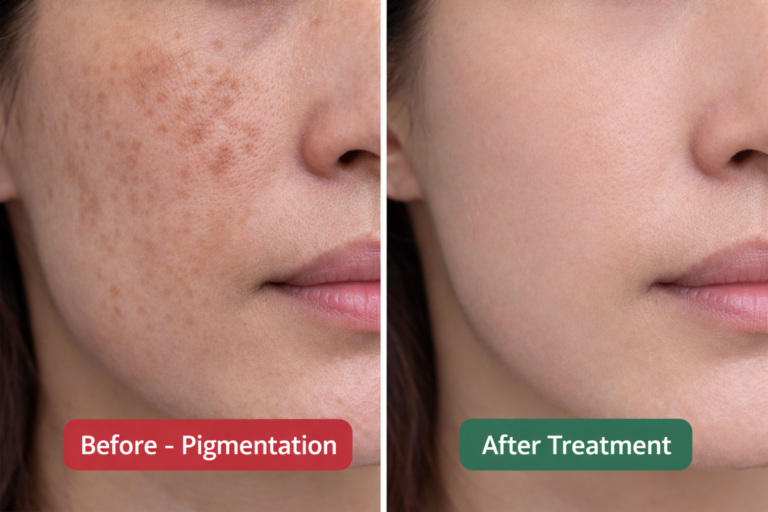
Pigmentation Treatment in Nagpur: Causes, Types & Treatment Options
Uneven skin tone, dark spots, patches and post-acne marks are some of the most common pigmentation concerns seen in dermatology.
Pigmentation can develop for many different reasons, which is why the right pigmentation treatment in Nagpur depends on identifying the type and underlying cause first.
What Is Skin Pigmentation?
Skin colour is influenced by a pigment called melanin.
When melanin production increases or becomes uneven in certain areas, the skin may appear darker than the surrounding skin.
This can result in:
- Dark spots
- Uneven skin tone
- Brown patches
- Post-acne marks
- Sun-related pigmentation
- Melasma
- Pigmentation after inflammation
Not every dark patch has the same cause, so treatment should begin with diagnosis rather than using the same brightening cream for every pigmentation concern.
What Causes Pigmentation?
Pigmentation can develop because of several factors.
Sun Exposure
Ultraviolet exposure can stimulate melanin production and make existing pigmentation more noticeable.
Sun exposure can also cause new dark spots to appear over time.
Acne
Inflamed acne can leave darker marks after the pimple heals.
If you are still experiencing active breakouts, read our guide on Acne Treatment in Nagpur.
Hormonal Changes
Hormonal factors may contribute to certain pigmentation patterns, particularly melasma.
Skin Inflammation
Pigmentation can appear after:
- Acne
- Skin irritation
- Rashes
- Injuries
- Certain procedures
- Other inflammatory skin conditions
Certain Medications or Medical Conditions
Some medications and underlying medical conditions can also affect skin pigmentation.
Age and Environmental Exposure
Repeated sun exposure and ageing can contribute to uneven skin tone and visible spots.
What Are the Common Types of Pigmentation?
Different pigmentation patterns may require different treatment approaches.
1. Post-Acne Pigmentation
After acne heals, flat brown or darker marks may remain.
These marks are different from true acne scars because they involve colour rather than a structural change in skin texture.
If both marks and scars are present, read our detailed guide on Acne Scars Treatment in Nagpur.
2. Melasma
Melasma commonly appears as symmetrical brown or grey-brown patches on areas such as:
- Cheeks
- Forehead
- Upper lip
- Nose
- Chin
Hormonal influences and sun exposure may contribute to melasma.
Because melasma can recur, long-term management and sun protection are often important.
3. Sun Spots
Repeated sun exposure may lead to darker spots on exposed areas such as the face and hands.
These may become more noticeable with age.
4. Post-Inflammatory Pigmentation
Any significant skin inflammation may leave temporary or persistent pigmentation afterward.
Examples include pigmentation after:
- Acne
- Eczema
- Skin irritation
- Scratching
- Injury
5. Uneven Skin Tone
Some patients do not have one specific dark patch but notice an overall lack of uniformity in their complexion.
The treatment approach depends on what is causing the uneven tone.
Pigmentation vs Acne Scars: What Is the Difference?
Pigmentation affects skin colour.
Acne scars affect skin structure or texture.
A flat brown mark after acne is not the same as a depressed acne scar.
This distinction matters because the treatment options differ.
For patients with active acne, dark marks and scarring, a staged treatment plan may be more appropriate than trying to treat everything simultaneously.
When Should You See a Dermatologist for Pigmentation?
Consider consulting a dermatologist when:
- Pigmentation keeps increasing
- Dark patches continue spreading
- Marks do not improve over time
- Pigmentation develops suddenly
- Over-the-counter products are irritating your skin
- Melasma keeps returning
- Acne marks remain for a long time
- You are unsure what type of pigmentation you have
A dermatologist in Nagpur can evaluate the type of pigmentation and help determine an appropriate treatment approach.
How Is Pigmentation Evaluated?
A dermatologist may consider:
- Colour of the pigmentation
- Distribution
- Depth
- Skin type
- Duration
- Sun exposure
- Acne history
- Hormonal factors
- Previous treatments
- Current skincare products
The objective is to identify what may be causing the pigmentation before choosing treatment.
Why Do Brightening Creams Sometimes Fail?
One common mistake is assuming that every dark patch requires the same brightening product.
Treatment may fail because:
- The diagnosis is incorrect
- The pigmentation is deeper
- Sun exposure is continuing
- Active acne or inflammation is ongoing
- The product is irritating the skin
- Treatment is stopped too early
- Multiple strong products are being used together
In some cases, irritation from aggressive skincare can itself make pigmentation worse.
What Treatments May Be Considered for Pigmentation?
Treatment depends on the type and severity of pigmentation.
Medical Skincare
Dermatologist-guided skincare may be recommended depending on the skin condition.
The objective may include:
- Reducing excess pigment production
- Managing acne or inflammation
- Supporting skin repair
- Preventing new pigmentation
Patients should avoid starting several strong active ingredients simultaneously without guidance.
Chemical Peels
Chemical peels use controlled exfoliating solutions to improve selected skin concerns.
Depending on skin type and diagnosis, peels may be considered for:
- Post-acne pigmentation
- Uneven skin tone
- Superficial pigmentation
- Acne-prone skin
- Dull skin
Learn more about Chemical Peel Treatments at Trichoderm Centre.
Chemical peels should be selected according to the patient’s skin rather than by choosing a peel only because it is popular.
Laser-Based Pigmentation Treatment
Selected pigmentation concerns may be considered for laser-based treatment.
The appropriate laser or device depends on:
- Pigmentation type
- Pigment depth
- Skin tone
- Previous treatments
- Individual response
Trichoderm Centre provides Aesthetic and Laser Dermatology for selected skin concerns.
Laser treatment is not automatically suitable for every type of pigmentation.
Q-Switch Laser
Q-Switch laser technology may be considered for selected pigmentation concerns depending on skin type and diagnosis.
It is important to first determine whether the pigmentation is appropriate for laser treatment.
The number of sessions and expected response vary between individuals.
Can Chemical Peels Remove Pigmentation Completely?
Chemical peels may improve certain types of superficial pigmentation, but no procedure should automatically be expected to remove every type of pigmentation completely.
Results depend on:
- Type of pigmentation
- Depth
- Skin type
- Sun exposure
- Aftercare
- Individual response
Some conditions such as melasma may require long-term management rather than a one-time treatment.
Why Is Sunscreen Important for Pigmentation?
Sun protection is one of the most important parts of managing pigmentation.
UV exposure can:
- Darken existing pigmentation
- Trigger new pigmentation
- Worsen melasma
- Reduce the effectiveness of treatment
A dermatologist can recommend suitable sun-protection measures according to your skin type and lifestyle.
Can Pigmentation Return After Treatment?
Yes, depending on the cause.
Pigmentation may return when:
- Sun exposure continues
- Hormonal triggers remain
- Acne continues
- Inflammation recurs
- Aftercare is not followed
- Melasma is present
This is why pigmentation treatment often includes both correction and prevention.
Melasma Treatment in Nagpur
Melasma can be one of the more persistent pigmentation concerns.
Treatment may involve a combination of:
- Dermatologist-guided skincare
- Sun protection
- Chemical peels in selected patients
- Other dermatological procedures where appropriate
Melasma treatment should be approached carefully because aggressive procedures may sometimes irritate the skin and worsen pigmentation.
Post-Acne Pigmentation Treatment
The first priority is controlling active acne.
If new pimples continue developing, new pigmentation may continue appearing.
Once acne is controlled, treatment may focus on:
- Dark marks
- Uneven tone
- Texture
- Acne scars where present
Read our guides on Acne Treatment in Nagpur and Acne Scars Treatment in Nagpur for a complete overview.
Common Pigmentation Treatment Mistakes
Using Too Many Brightening Products
Combining several active ingredients can irritate the skin.
Skipping Sunscreen
Treatment may provide limited benefit if pigmentation continues to be triggered by sun exposure.
Choosing Procedures Without Diagnosis
Different pigmentation types require different approaches.
Using Strong Home Peels
Unsupervised acids or strong peeling agents can cause irritation and worsen pigmentation.
Expecting Instant Results
Pigmentation usually improves gradually.
Stopping Treatment Too Early
Some pigmentation concerns require consistent treatment and long-term prevention.
How to Choose a Pigmentation Doctor in Nagpur
When searching for pigmentation treatment in Nagpur, consider a clinic where the treatment process begins with proper diagnosis.
Look for:
Dermatologist-Led Assessment
Pigmentation should be evaluated before a procedure is selected.
Personalised Treatment
Skin tone, pigmentation type and sensitivity differ between patients.
Medical and Procedural Options
A comprehensive dermatology clinic can choose between medical skincare, chemical peels and laser-based approaches depending on the condition.
Realistic Expectations
Some pigmentation can recur, so prevention and maintenance may be important.
Pigmentation Treatment in Nagpur at Trichoderm Centre
With 8+ years of experience and 10,000+ patients treated, the clinic focuses on personalised, safe and evidence-based treatment.
Depending on the skin assessment, treatment may include Medical Dermatology, Chemical Peel Treatments or selected Aesthetic and Laser Dermatology options.
Frequently Asked Questions About Pigmentation
What causes skin pigmentation?
Pigmentation may develop because of sun exposure, acne, inflammation, hormonal factors, ageing or other skin conditions.
Is pigmentation the same as acne scars?
No. Pigmentation affects skin colour, while true acne scars affect skin structure or texture.
Can Chemical Peels help pigmentation?
Selected chemical peels may help certain types of superficial pigmentation and uneven skin tone depending on the patient’s skin and diagnosis.
Can laser treatment help pigmentation?
Selected laser treatments may be considered for certain pigmentation concerns. Suitability depends on skin type, pigmentation type and depth.
Does pigmentation come back?
Some pigmentation can recur, particularly when triggers such as sun exposure or hormonal factors remain present.
How long does pigmentation treatment take?
The timeline varies according to pigmentation type, depth, treatment chosen and individual response.
Should I see a dermatologist for melasma?
Yes. Melasma can be persistent and may require dermatologist-guided management and long-term sun protection.
Start with the Right Pigmentation Diagnosis
Not every dark spot requires the same treatment.
Post-acne marks, melasma, sun pigmentation and inflammation-related pigmentation may look similar but behave differently.
A dermatologist-led evaluation helps identify the type of pigmentation before deciding whether skincare, chemical peels, laser treatment or another approach may be appropriate.